

Traditional Laser Hair Removal machines typically use a single wavelength of light to target pigment in the hair follicle. (This is typically 755 nm, 808 nm or 1064 nm.)
The Soprano Titanium device combines all three wavelengths in one single applicator. This results in damage to three distinct depths of the hair follicle simultaneously, while delaying regrowth without harming surrounding tissue. This technology can be used on everyone, regardless of skin type or hair colour.
Here’s how the wavelengths differ:
The Alexandrite 755nm – This wavelength is used to target a wide range of hair colours and types, including thin hair and light-coloured hair. It can even address embedded hair.
The SPEED 810 nm – This wavelength is used for darker skin types and targets the deeper hair follicle. It has a moderate tissue penetration depth, making it suitable for treating areas such as the arms, legs, cheeks and chin.
The YAG 1064 – This is the most penetrative wavelength. It is ideal for treating embedded hairs, such as those in the armpits and pubic area. It targets the deepest part of the follicle for the most effective Laser Hair Removal treatment possible.
By combining the absorption and penetration levels of different wavelengths, along with extended treatment coverage, increased comfort and low maintenance requirements, Soprano Titanium is the most effective hair removal treatment available today.
Suitable for All Skin Types
Previously, traditional Laser Hair Removal required limited sun exposure; therefore, those who regularly tanned or used fake tan could not undergo treatment. The Soprano Titanium is the only TGA-approved laser on the market that can be used on all skin types, including tanned skin.
Understanding The Treatment
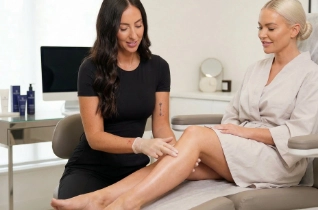
The Soprano Hair Removal procedure is straightforward. First, you will lie on a treatment bed and make yourself comfortable. We will provide you with protective eyewear as a safety measure.
A thin layer of clear gel is applied to the area to allow the laser to slide without friction. Your cosmetic nurse will then run the laser handpiece over the area in a sweeping motion, maintaining contact with the skin at all times. The handpiece delivers small bursts of energy to heat hair follicles and cause targeted damage gently.
You will feel the area warm slightly over the course of the treatment; however, the patented DualChil treatment tip on the handpiece will keep your skin cool and comfortable. The treatment may be mildly uncomfortable in sensitive or intimate areas.
Depending on the area being treated, the skin may turn slightly red. Treatment times vary depending on the individual and the area being treated. Some treatments last only 10 minutes, while others require longer.
The Soprano Titanium also has a unique Quattro handpiece. This is the largest applicator head on the market, reducing treatment time by up to 40%.
Results
You can expect to see at least an 80 per cent reduction in unwanted hair after several treatments.
Hair grows in stages; therefore, all hair on the body will be at different stages at any one time. A laser is most effective at targeting hair in the first stage of hair growth. No laser can destroy all the hair follicles at one time. Some follicles may be completely destroyed, while others may be reduced to fine hairs or shocked into prolonged dormancy. Therefore, multiple treatments are necessary to ensure that all hairs are targeted at their early stage.
Number of Sessions Required
We usually recommend a course of six to eight laser treatment sessions to reduce hair growth permanently. This is because some of the follicles in the treatment area won’t be in the targeted growth phase at any given time. We must face the treatments to ensure that any hair that may not have been as actively treated in one session is affected in the next.
Facial hair tends to be more stubborn and may require 10 to 20 treatment sessions.
Time Between Sessions
We typically recommend a 4- to 6-week gap between sessions for facial areas and a 6- to 8-week gap for body areas. The number of hair removal sessions required depends on factors such as location, hair thickness, hair colour and skin type. For optimal results, we recommend completing the full course of treatment sessions.
Hair Removal Between Sessions
Before commencing treatment and in between treatments, we recommend shaving. Do not wax or pluck hairs between treatments. These hair removal methods remove hair at the root, making it impossible for the laser to act on them and rendering the treatment ineffective.
Pre-Treatment Information
To help optimise your treatment results and minimise the risk of complications, please follow these pre-treatment instructions:
- Use SPF 30 sunscreen daily. Sunburned skin cannot be treated.
- Avoid skin irritants such as hydroquinone, bleaching creams, tretinoin, retinol creams, benzoyl peroxide, chemical peels, glycolic acid and salicylic acid for at least two weeks before the procedure.
- If you have a history of hyperpigmentation (darkening of the skin) with laser treatments or trauma to the skin, please let us know.
- Do not wax, thread, or have electrolysis for four to six weeks before your treatment and/or between treatments.
- Do not wear makeup, perfume, or lotions on the treatment area on the day of treatment.
- Before each treatment, please inform us if you are taking new antibiotics or medications, as they may increase your skin’s sensitivity to light treatments and therefore, we might not be able to treat you for up to two weeks after completing the antibiotics.
- Shave the treatment area on the day of your appointment.
- It is critical that you are not using topical or oral steroids (creams or pills) or Accutane/Roaccutane (within the last six months).
- Tattooed areas cannot be treated with a laser unless for tattoo removal.
- If you are pregnant or breastfeeding, you are NOT a candidate for laser treatment.
- If you have a history of cold sores or peri-oral HSV, please let your doctor/therapist know. Medication can be prescribed to reduce the risk of an outbreak after your treatment.
Following Your Treatment
Following your Laser Hair Removal treatment, you may notice redness and bumps at the treatment site that can last several days. It is normal for the treated area to sting for a few hours post-treatment.
Some post-treatment recommendations may include:
- Use a cool compress and aloe vera gel (keep it cold in the fridge)
- Use SPF 30 sun protection daily over the treated area for at least four weeks after treatment to minimise the risk of any discolouration.
- Do not pick, as scabbing can lead to scarring.
- Makeup can be used over the treatment area so long as there is no extended redness, blistering or scabbing (mineral makeup is the best option).
- Avoid sun exposure for four weeks after treatment to reduce the risk of any pigmentation changes.
- Avoid hot water to the skin until initial skin irritation subsides.
- Avoid skin irritants such as hydroquinone, bleaching creams, tretinoin, retinol creams, benzoyl peroxide, chemical peels, glycolic acid and salicylic acid for at least two weeks after the procedure.
- Avoid any rubbing or friction on the treated area for three days post-treatment.
- The treated area may be washed gently with shower gel or a mild cleaner. The skin should be patted dry and NOT rubbed.
- After a pigmentation treatment, the pigment may become darker and remain dark for three to four days post-treatment. The darkened pigment will gradually shed from the skin or slowly fade and be reabsorbed by the body. Broken capillaries may appear slightly darker initially but will gradually clear following treatment.
Risks & Complications
All non-surgical treatments, including Laser Hair Removal, carry potential risks and side effects. These must be considered before undergoing treatment. Although the risks associated with hair removal are extremely uncommon, the following may occur:
- lightning or darkening of the skin in the treated areas
- skin crusting or blistering
- infection
- scarring
Please contact the clinic immediately if you experience any inflammatory reaction or side effects. If necessary, additional treatments, medications or surgery may be necessary.
