

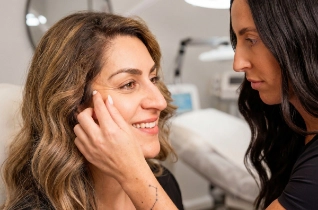
Crow’s Feet develop slowly over time, due to repeated muscle movements and structural changes in our skin.
Contributing factors can include:
- sun exposure
- volume changes in the midface
- age-related collagen and elastin changes
- repetitive smiling and squinting
- skin thinning
- genetic predisposition>
Your Treatment Options
To determine the most appropriate treatment options for you, we must assess your skin quality, muscle movement patterns, anatomy and any volume changes that may be affecting the appearance of lines around the eyes.
Muscle Relaxant Treatment: This treatment blocks the transmission between the nerve and the orbicularis oris muscle (the circular muscle surrounding the eye), minimising muscle contraction in this area. When muscle activity decreases, Crow’s Feet may appear softer and less visible during expression.
Some individuals have fine lines that extend slightly beneath the eyes. In these cases, we can carefully use microdosing techniques, placing the product superficially into the lower fibres of the orbicularis oris to soften the appearance of these lines.
When treating this area, good technique is essential. Underneath the lower fibres of the orbiculris oris are muscles involved in facial movement, including muscles responsible for lifting the upper lip. If the product is placed too deeply, these muscles may be affected. Therefore, conservative dosing and controlled depth are vital.
Skin Boosters: These products are generally used to support skin quality and reduce the appearance of fine lines. There are a variety of skin boosters available and they can be used on their own or in tandem with muscle relaxant treatment.
Volume Skin Boosters: These skin boosters are made from a synthetic complex sugar designed to mimic the naturally occurring complex sugar found within skin tissues. When placed just below the skin’s surface, they form a light, supportive layer that may help minimise the appearance of fine lines under the eye area.
Polynucleotides: Derived from purified salmon DNA, polynucleotides support cellular repair processes and fibroblast activity (primary cells responsible for collagen and elastin production).
Other treatments: Various treatments are available to support skin health and minimise the appearance of fine lines, including skin needling, light-based therapies, chemical peels and laser devices (non-ablative or ablative).
Your In-Person Consultation
To assess the factors that may be contributing to your Crow’s Feet, you’ll first need a thorough in-person consultation. After the assessment, we can discuss a tailored treatment plan, providing you with all the information you need to make an informed decision about how you’d like to proceed.
Cost
The cost of your Crow’s Feet treatment depends on the individualised treatment plan recommended for you and the treatment option/s included. This will be discussed during your in-person consultation.
Comfort During Treatment
During your initial consultation, we’ll discuss comfort measures that are suitable for your treatment. Options can include a topical anaesthetic, a local anaesthetic administered via needle or, if required, happy gas (nitrous oxide).
Risks & Complications
All aesthetic medicine treatments carry risks that vary depending on the treatment. Before you proceed with treatment, we’ll discuss these risks with you. To learn more, please see our Potential Risks and Complications page.
